At the Lagos College of Medical Sciences, we are dedicated to empowering individuals with the essential skills and knowledge required to excel in their respective careers. Our Skills and Professional Development Center (SPDC) offers high-quality training programs specifically designed to enhance professional competencies and prepare individuals to respond effectively in Healthcare sector.
Overview of Our Training Programs
Our courses adhere to global standards and are tailored for professionals across various sectors, including healthcare, education, corporate environments, community organizations, and emergency response teams.
1. First Aid and CPR (1 day)
A comprehensive 1-day course covering essential first aid techniques and cardiopulmonary resuscitation (CPR) procedures. Participants will learn how to:
- Manage minor injuries, control bleeding, and handle emergencies
- Recognize cardiac arrest, perform CPR, and use automated external defibrillators (AEDs)
Professionals with First Aid and CPR certification can work in:
- Hospitals and healthcare systems
- Ambulance services and EMS agencies
- Fire departments and rescue services
- Industrial and corporate settings
- Schools and educational institutions
- Sports teams and athletic organizations
- Community centers and non-profit organizations
- Fitness centers and gyms
2. Basic Life Support Provider Course (1 Day)
The Basic Life Support (BLS) course equips participants with the necessary skills to provide basic life support in emergency contexts. Participants will learn to assess patients, provide oxygen, and manage airways effectively.
Individuals with BLS certification can pursue careers in:
- Hospitals and healthcare institutions
- Ambulance services and EMS agencies
- Fire departments and rescue services
- Industrial and corporate environments
- Educational institutions
- Sports organizations and athletic teams
- Community health centers
3. Advanced Cardiac Life Support (2 Days)
This two-day course builds upon basic life support skills, offering advanced training in cardiac life support techniques and procedures. Participants will learn to manage complex cardiac cases, interpret electrocardiograms (ECGs), and administer medications.
Individuals with Advanced Cardiac Life Support certification can find employment in:
- Hospitals and healthcare institutions
- Ambulance services and EMS agencies
- Fire departments and rescue services
- Cardiac care units and catheterization laboratories
- Intensive care units (ICUs)
- Emergency departments
- Medical transport services
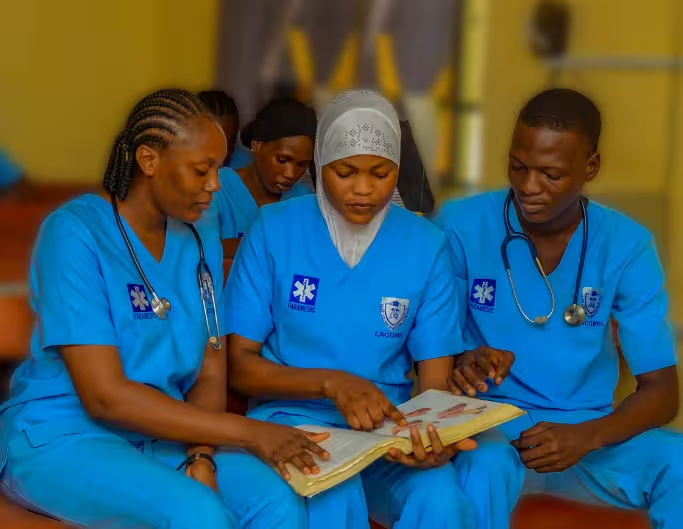
4. Emergency Care Provider (7 Days)
This comprehensive program is ideally suited for emergency responders, disaster relief teams, and healthcare workers in remote environments. The course encompasses advanced first aid, trauma care, and patient transport, preparing participants to handle a wide range of emergency situations competently.
Individuals with Emergency Care Provider certification can work in:
- Hospitals and healthcare institutions
- Ambulance services and EMS agencies
- Fire departments and rescue services
- Emergency departments
- Urgent care centers
- Remote area medical services
- Humanitarian organizations and non-governmental organizations (NGOs)
Certification and Renewal
Upon successful completion of each course, participants will receive internationally recognized certificates. Certifications are valid for a term of two years, and renewal is required to ensure participants remain informed of the latest protocols and techniques.
Reasons to Choose our SPDC
Our training programs are designed to equip participants with the skills, knowledge, and confidence essential for excelling in their careers. By selecting SPDC, participants can expect:
Expert instruction from seasoned trainers
Hands-on training and practical exercises
Comprehensive course materials and resources
Certification acknowledged by industry professionals
Frequently Asked Questions
Admission into Lagos College of Medical Sciences is based on programme eligibility and academic readiness.
For ND Programmes
Applicants must possess a minimum of five credits in WASSCE, NECO, GCE, or NABTEB. These must include English Language, Mathematics, Biology, Chemistry, and one other relevant science subject. Results should be obtained in not more than two sittings.
For HND Programmes
Applicants must have completed a National Diploma in a relevant health or science related discipline with a minimum of Lower Credit.
For Professional and Short Courses
Entry requirements vary depending on the course. Detailed requirements are clearly stated under each programme description.
Yes. LACOMS provides financial aid support to qualified and deserving students.
We understand that access to quality education is essential, and financial limitations should not hinder talent and ambition. Our financial support options are designed to ease tuition burden and support students throughout their academic journey.
Availability and eligibility may vary by programme, and interested applicants are encouraged to contact the admissions office for guidance.
The LACOMS application process is straightforward and fully online.
- Navigate to the Admission section and select your desired programme.
- Pay the application fee securely through the online payment portal.
- Complete the online application form and upload all required documents.
- Submit your application and print your confirmation slip.
Once submitted, applications are reviewed by the admissions team, and shortlisted candidates will be contacted with next steps.
A paramedic is a highly trained healthcare professional who provides emergency medical care and transportation to individuals in need. Paramedics are often the first point of contact in emergency situations, providing critical care and stabilization until patients reach a hospital or medical facility.
Key Responsibilities:
- Respond to emergency calls and provide medical care
- Assess patients’ conditions and provide treatment
- Administer medications and perform medical procedures
- Transport patients to medical facilities
- Communicate with patients, families, and healthcare teams
Paramedics work in various settings, including:
- Emergency Medical Services (EMS)
- Hospitals
- Fire departments
- Private ambulance services among many others
Paramedic Roles in Nigeria:
- Provide emergency care in pre-hospital settings
- Assist in disaster response and management
- Support healthcare teams in hospitals and clinics
At LACOMS, paramedics are trained through rigorous academic instruction, simulation drills, clinical rotations, and real-world emergency exposure to prepare them for lifesaving roles in the healthcare system.
All required documents are submitted online during the application process.
Applicants will be prompted to upload scanned copies of their academic credentials and supporting documents while completing the application form. If additional documentation is required, the admissions office will contact the applicant directly.
For assistance or clarification, applicants may contact the admissions office via
Email: info@lacoms.education
Phone: +2348140045335
WhatsApp: +2348140045335